

What is Cleanlab Trustworthy Language Model?
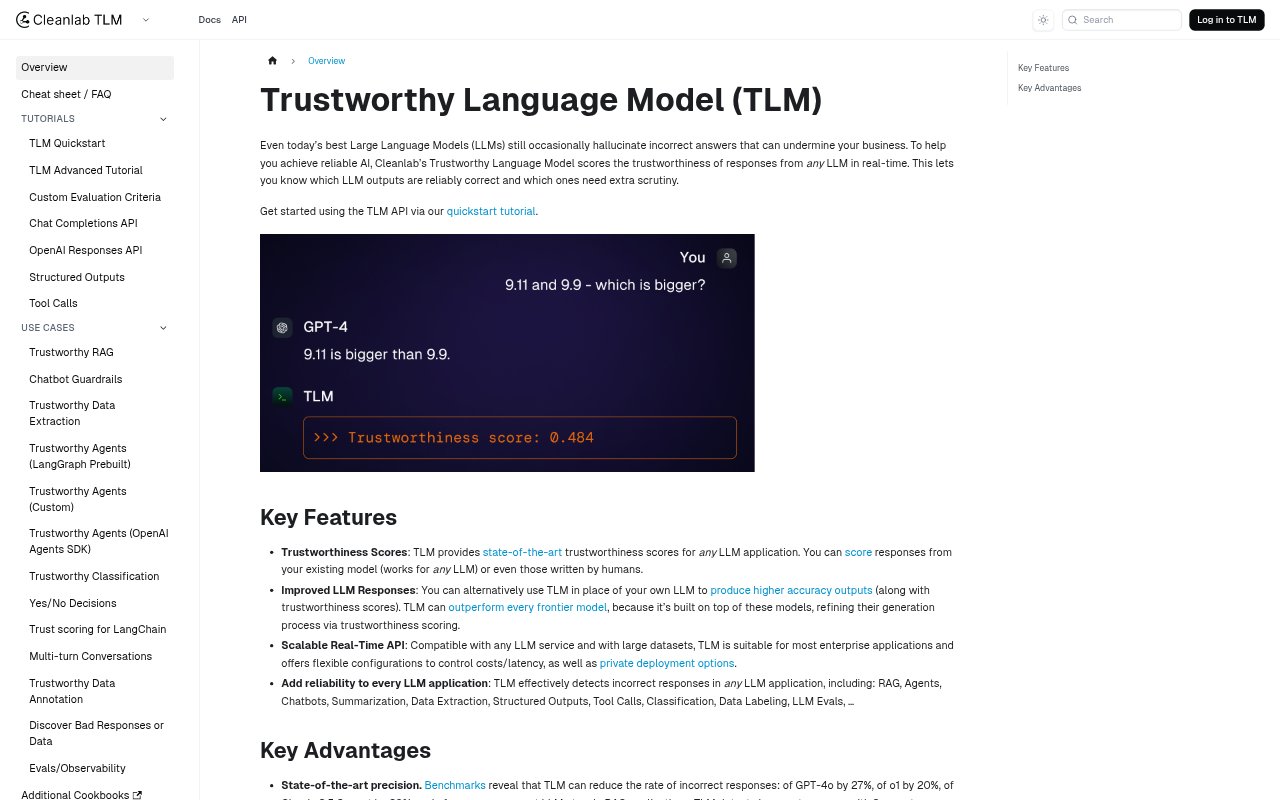
Trustworthy Language Model (TLM) adds a reliability check to applications that use large language models by scoring how trustworthy each response is in real time. It can assess output from an existing model, including human-written responses, or generate responses itself with a trustworthiness score. Cleanlab presents it for teams building RAG systems, chatbots, agents, and other LLM workflows that need to identify outputs requiring extra scrutiny before they reach users or enter downstream processes.
Cleanlab Trustworthy Language Model Features:
Real-Time Scoring: TLM assigns trustworthiness scores to responses from any LLM, including output generated by an existing model or written by a person.
Improved Generation: TLM can generate answers in place of an application's own LLM and return a trustworthiness score alongside them.
Custom Criteria: Teams can configure evaluation criteria for concerns such as instruction following, brand safety, personal information, and relevance.
RAG Component Checks: For retrieval-augmented generation, TLM evaluates the response and can assess retrieved context, including its sufficiency, to help locate problems.
LLM Compatibility: TLM is designed to work with any LLM service and RAG architecture, including different models and retrieval or indexing methods.
API Configuration: Its real-time API supports large datasets, with configuration options for balancing latency and cost and options for private deployment.
Cleanlab Trustworthy Language Model Benefits:
Focus Review: Reviewers can direct their attention to answers that appear less trustworthy instead of treating every generated response alike.
Catch Errors: Identifying questionable answers before they are used or shown can reduce the risk that incorrect output undermines customer confidence.
Find Root Causes: Teams can investigate whether an unreliable answer stems from insufficient retrieved context or another part of the RAG workflow.
Skip Dataset Prep: Because TLM does not require training on a team's data, teams can evaluate responses without preparing and labeling a task-specific dataset.
Support Model Changes: Compatibility with different LLMs can help teams keep their reliability checks in place as they change the model powering an application.
Use Cases:
Customer Support RAG: Check chatbot answers against retrieved service-policy material before presenting them to customers seeking support.
Chatbot Guardrails: Screen customer-facing replies for inaccurate claims, unsafe language, off-brand tone, personal information, or irrelevant content.
Agent Workflows: Score responses from an LLM agent workflow to find outputs that may need scrutiny before an agent replies or takes a next step.
Structured Extraction: Assess LLM-generated structured outputs or extracted information before passing the results into a business process.
LLM Evaluation: Use trust scores to discover problematic responses or review output quality across an evaluation workflow or dataset.