

What is mesmer-ai-detector-4b?
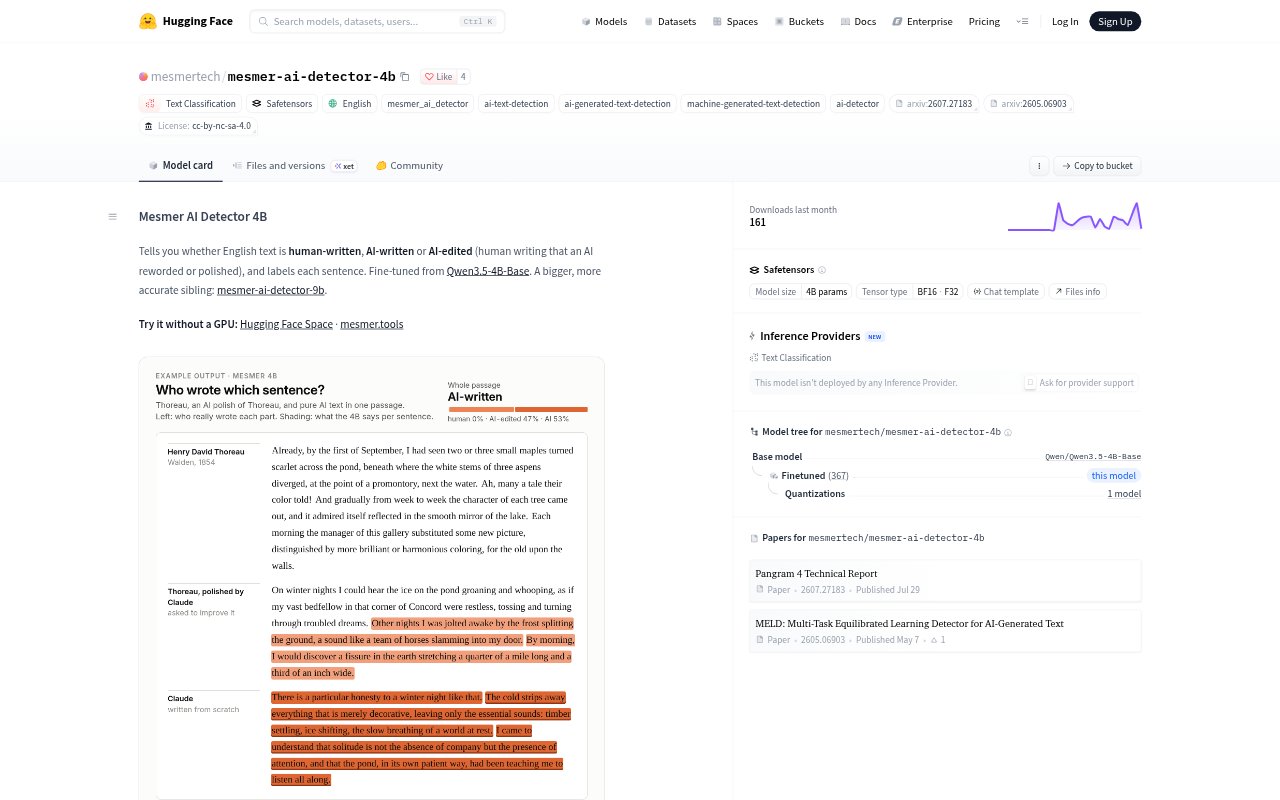
Mesmer AI Detector 4B is an open-weight text classification model for assessing whether English writing is human-written, AI-written, or human writing that an AI has edited. It also assigns a label to each sentence, giving reviewers more detail than a single document-level verdict. The model is intended for people who need to inspect text provenance, including writers, educators, editors, and researchers. It is English-only, and results on texts under about 50 words are unreliable.
mesmer-ai-detector-4b Features:
Three-Way Classification: The model distinguishes human-written text, AI-written text, and human writing that an AI has reworded or polished.
Sentence-Level Labels: Alongside its assessment of the text, it labels each sentence so users can identify where different classifications appear.
Open Weights: Weights are available in bf16 at 8.4 GB and int8 at 4.2 GB, with the int8 version using 4.9 GB once loaded.
Hosted Trial: A Hugging Face Space offers a way to try the model without a GPU, and the hosted tool refuses texts shorter than 40 words.
Decision Thresholds: Default thresholds were set using held-out human texts to limit AI-written verdicts to at most 0.7% and any flag to at most 1%.
Noncommercial License: The model is distributed under CC BY-NC-SA 4.0, which permits non-commercial use with attribution and share-alike.
mesmer-ai-detector-4b Benefits:
Focused Review: Sentence-level results help reviewers spend their attention on the passages the model flags instead of treating a whole document as uniformly suspicious.
More Context: Separating AI-edited writing from fully AI-written text gives users a more nuanced starting point for discussing how a passage was produced.
Local Evaluation: Available weights let teams assess whether the model suits their workflow and data-handling needs before deciding how to use it.
Lower False-Flag Risk: The default thresholds are tuned to limit flags on held-out human writing, which can reduce unnecessary follow-up when screening text.
Cautious Decisions: Its stated limitations make clear that a detector result should inform review rather than serve as the sole basis for an accusation.
Use Cases:
Essay Review: An educator can use the sentence labels to identify passages for a conversation about an English-language essay, while treating the output as one signal rather than proof.
Editorial Screening: An editor reviewing submitted English copy can use the classifications to decide which passages merit closer discussion with the writer.
Academic Abstracts: A research team can test the detector on academic abstracts, a type of human writing that the model notes may be flagged, before relying on it for screening.
Writing Research: Researchers can compare classifications across human, AI-written, and AI-edited English samples when studying text provenance.
Model Evaluation: A team can run the hosted demo or load the weights to assess the detector on its own suitable-length English examples before adopting it.