

What is Pangram?
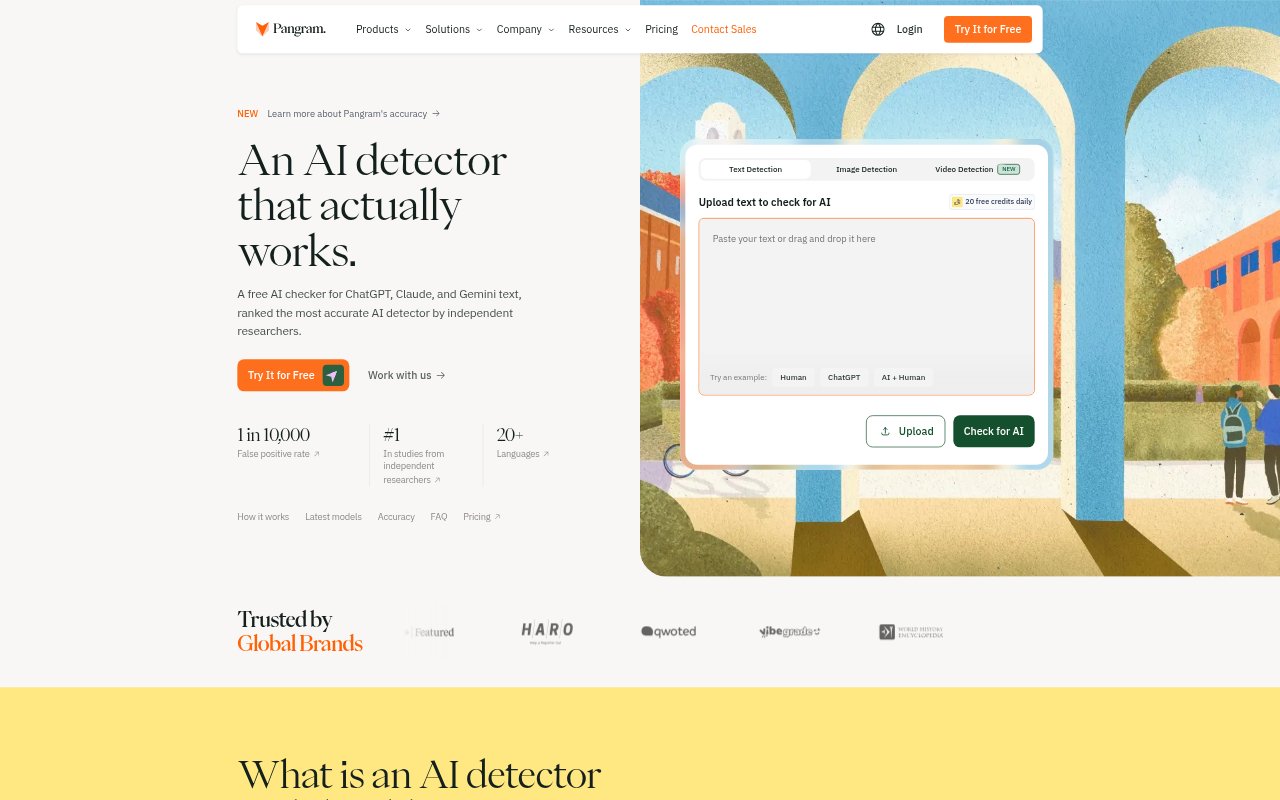
Pangram is a text-authenticity checker for people and organizations that need to assess whether writing was produced by a person, generated by AI, or edited with AI. It also checks text for similarity to other material and can analyze images and videos for AI generation. Users can paste text or upload documents, review marked results, and access the tool through web-based workflows, integrations, or an API.
Pangram Features:
Text Authorship Detection: The detector analyzes writing for patterns associated with major language models, including ChatGPT, Claude, Gemini, Llama, and other AI systems.
Image and Video Checks: Users can upload images or videos to check for AI generation, alongside Pangram’s text-authorship and similarity tools.
Segment-Level Results: Results include an AI likelihood score and highlighted passages, with segments classified as human, AI-assisted, or AI-generated.
Similarity Checking: The similarity checker looks for plagiarism and can run alongside AI detection in a single check.
Document Uploads: Text can be pasted or uploaded as PDF, DOCX, or RTF files, with support for scanning up to 100 files at a time.
Multilingual Detection: Pangram checks AI-written and human-written text in 24 languages, including Spanish, French, Arabic, Chinese, and Japanese.
Workplace Integrations: Access is available through a browser extension, Google Docs, Gmail, learning management systems, and an API.
Pangram Benefits:
More Informed Reviews: Scores and highlighted passages give reviewers specific evidence to consider instead of relying only on an overall impression of a document.
Fairer Assessment: Separating human, AI-assisted, and AI-generated passages can help educators discuss authorship with more nuance when evaluating student work.
Fewer Separate Checks: Running similarity and AI checks together gives teams a broader view of text authenticity in one review workflow.
Broader Language Coverage: Multilingual checks let institutions and businesses review material in many languages without switching to a different detector for each one.
Easier Team Adoption: Browser, document, email, and LMS access lets people check text within familiar work environments rather than moving between separate tools.
Use Cases:
Classroom Assessment: Teachers can review essays for AI-generated passages and similarity when considering how a student completed an assignment.
University Policy: Higher education teams can use detection results within LMS workflows to support the application of institutional AI policies.
Publishing Review: Editors can examine submitted articles or manuscripts for AI-written sections and potential plagiarism before making publication decisions.
Newsroom Verification: Journalists and editors can check written material when assessing whether its authorship aligns with newsroom standards for integrity.
Legal and HR Review: Law firms or recruiting teams can inspect relevant written documents when authorship is part of their review process.