

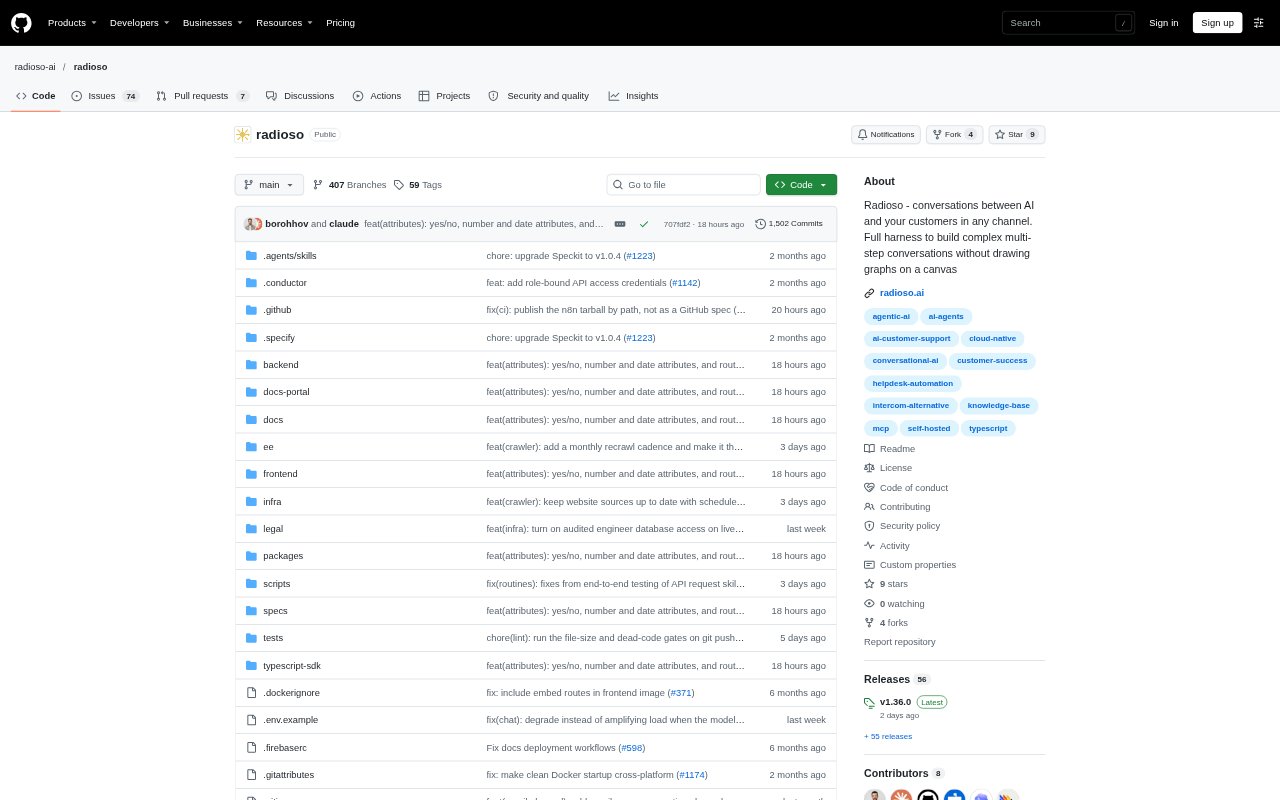
What is Radioso?
Radioso is an open-source customer-service platform for teams that want AI agents to answer customers and carry out service work. It grounds responses in a help center and policies, can qualify leads, and supports routines and human handoffs. Teams can run it in Radioso Cloud or self-host the platform, with agents available through web, Slack, API, SDK, and MCP. It is also intended for builders embedding support in their products and knowledge-base teams sharing answers internally and externally.
Radioso Features:
Grounded Answers: Agents source responses from help-center content and policies, with citations so customers and staff can see the basis for an answer.
Directives: Teams set rules that steer agent behavior, allowing answers and actions to follow their own policies and instructions.
Routines and Actions: Agents call tools, fire webhooks, and run multi-step routines for work such as returns and escalations.
Human Handoff: When an issue needs a person, the agent can transfer the conversation with its full transcript and actions attached.
Channel Access: Teams can make agents available through web embeds, Slack, API, SDK, and MCP, using the same knowledge and rules across channels.
Cloud or Self-Host: Run the platform in Radioso Cloud or on your own infrastructure, using your own model keys or Radioso's.
Radioso Benefits:
Shared Knowledge: Curating content once keeps answers aligned across customer and staff channels, rather than maintaining separate copies for each service tool.
Less Routine Queue: Agents can resolve straightforward support requests end to end, leaving staff more time for cases that need judgment.
Traceable Responses: Citations make it easier for users to check what an answer relies on before acting on the guidance.
Context at Handoff: Transferring a transcript and completed actions helps a human pick up a difficult case without asking the customer to repeat the history.
Flexible Cost Control: Conversation-based plans avoid seat and resolution charges, while self-hosting removes conversation limits and inference markup.
Use Cases:
Routine Ticket Resolution: Automate common help-center inquiries and routine support work, escalating harder cases to staff with the conversation history attached.
Returns and Escalations: Configure agents to carry out return or escalation routines according to company rules, then hand off cases that need human attention.
Lead Qualification: Use an agent to answer prospective customers and qualify leads through the same service channels used for customer support.
In-Product Support: Add grounded answers and actions to a company app or site so customers can get help where they already use the product.
Internal Knowledge Access: Let staff ask questions in Slack while customers use an embed or public chat, drawing from a shared curated source.