
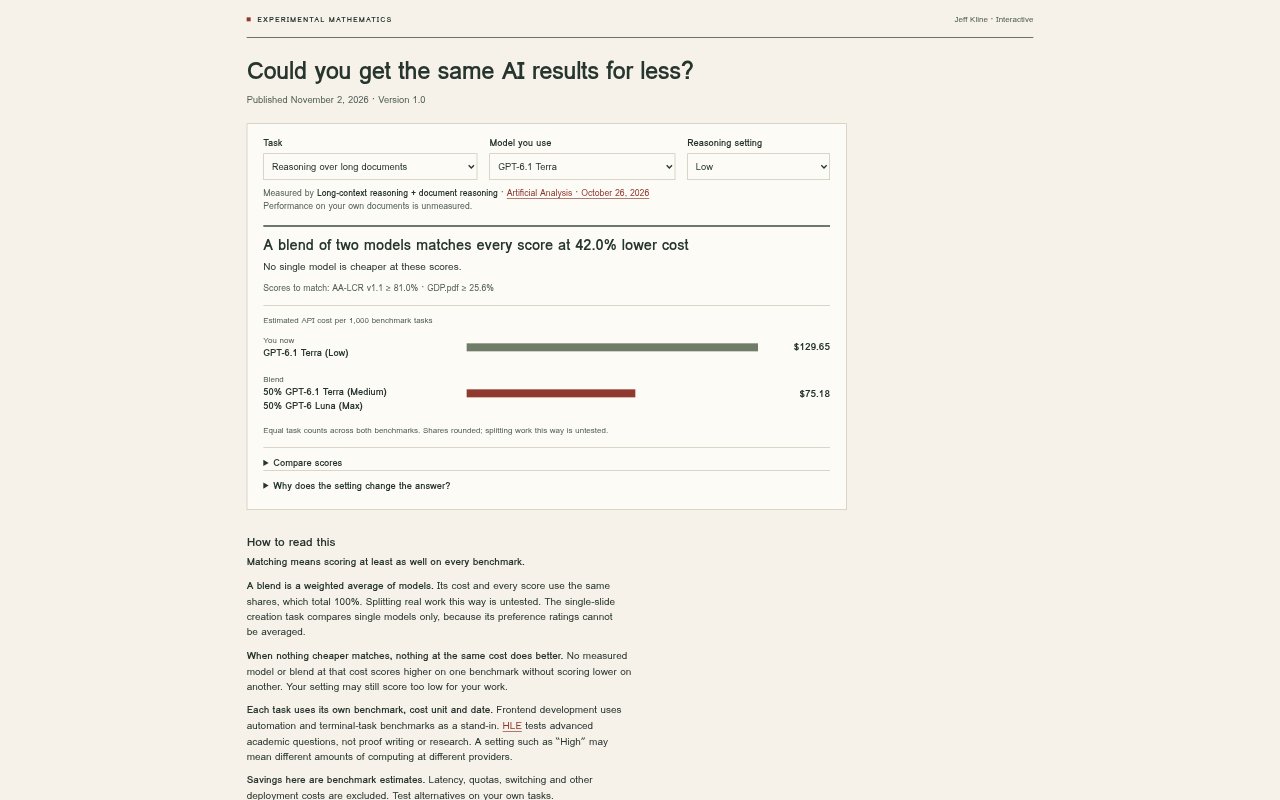
What is Could you get the same AI results for less??
This interactive comparison helps people choosing language models assess whether a lower-cost model or weighted blend can match a selected model’s benchmark performance. Choose a task, model, and reasoning setting to see the cheapest measured option that scores at least as well on every benchmark for that setting. It is for comparing model cost and benchmark results, not for predicting deployment performance.
Could you get the same AI results for less? Features:
Task Selection: Compare measured options by task, with each task using its own benchmark, cost unit, and calculation date.
Reasoning Settings: Choose a model and reasoning setting, then inspect the benchmark scores and lowest-cost match for that configuration.
Score Matching: A match must equal or exceed the selected model on every benchmark, rather than just on one combined score.
Weighted Blends: Evaluate blends as weighted model averages, with the same shares determining both the combined scores and estimated cost.
Cost Estimates: See the lowest measured cost per 1,000 tasks for each setting, based on a model or blend.
Single Models: For single-slide creation, compare individual models only, because preference ratings cannot be averaged across a blend.
Cost Scope: The estimates exclude latency, quotas, switching, and other deployment costs, so they cover benchmark cost rather than total operating expense.
Could you get the same AI results for less? Benefits:
Budget Visibility: A matched-score cost comparison helps show whether higher spending corresponds to better measured performance for a chosen task.
Tradeoff Clarity: Per-benchmark matching makes it harder to overlook an option that scores well overall but falls short on one measure.
Task Context: Separate benchmarks and cost units help keep comparisons tied to the work being evaluated instead of treating tasks as interchangeable.
Measured Savings: Benchmark-based estimates can reveal candidates for lower-cost testing without presenting possible savings as guaranteed in production.
Evaluation Focus: The results help narrow the alternatives worth checking on your own tasks before making a model choice.
Use Cases:
Model Review: Compare model and reasoning-setting alternatives before choosing one for a task represented in the benchmark results.
Cost Planning: Estimate the measured cost of 1,000 tasks when seeking an option that matches a selected model’s benchmark scores.
Blend Exploration: Check whether weighted shares of different models could meet a target score profile at a lower estimated cost.
Frontend Evaluation: Review the frontend-development comparison, which uses automation and terminal-task benchmarks as a stand-in for that work.
Academic Questions: Examine model tradeoffs for advanced academic questions using HLE, while keeping in mind that it does not test proof writing or research.
Slide Creation: Compare individual model results for single-slide creation, where preference ratings are not combined across blends.