

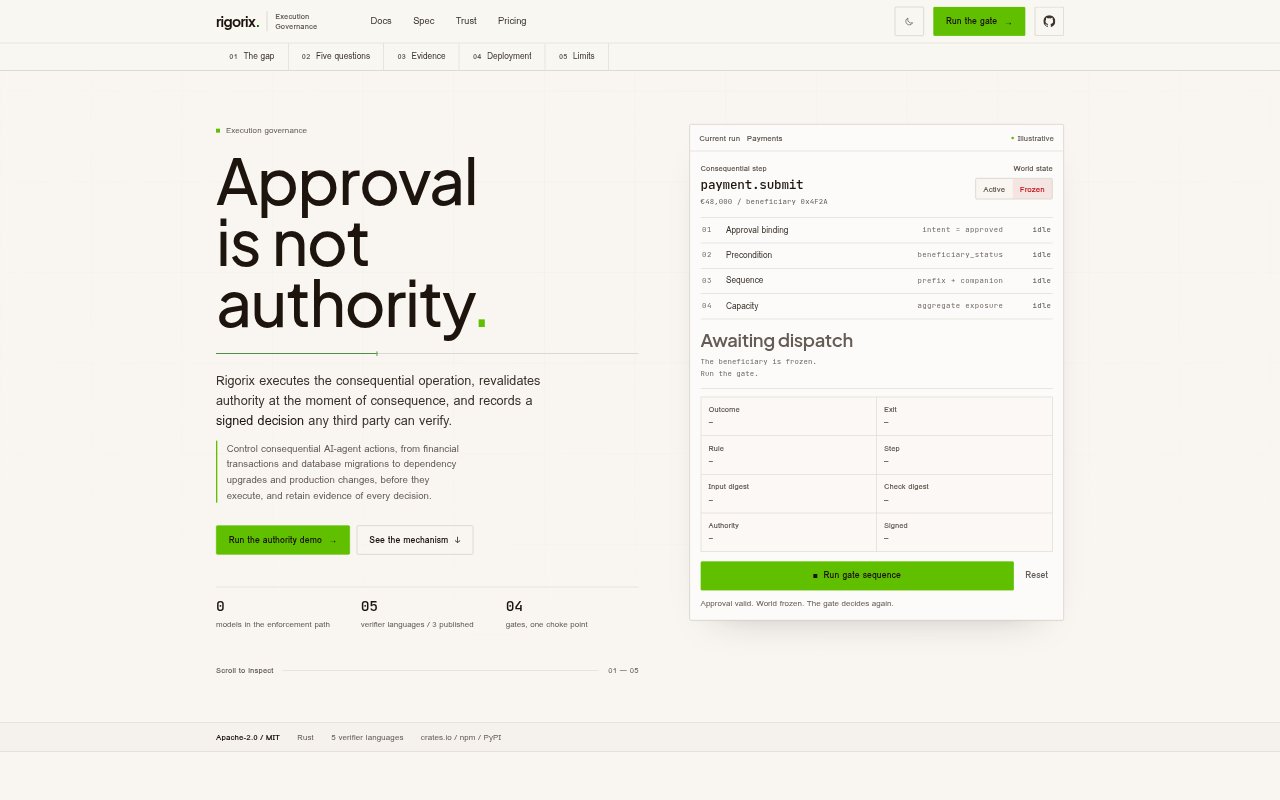
What is Rigorix?
Rigorix is an execution-governance engine for consequential actions initiated by AI agents, including payments, database migrations, dependency upgrades and production changes. It checks whether an action may proceed just before dispatch and creates signed evidence of the decision, including refusals. The engine can run locally as open-source software, while an optional self-hosted control plane adds organisation-wide policy, audit and operations without moving the enforcement decision out of the engine. The engine and verifier packages are free.
Rigorix Features:
Dispatch-Time Authority: Rigorix rechecks authority immediately before an operation dispatches, so an earlier approval does not automatically authorize an action after circumstances change.
Ordered Plans: Policy is checked at plan time against the run prefix and signed history across runs, refusing out-of-order steps before they reach their effect.
Live Preconditions: Operator-authored checks can read authority, eligibility, limits or freeze status immediately before dispatch, and anything other than a definite pass refuses the step.
Canonical Effect Keys: A key defined by the operator identifies actions by their consequences, allowing the gate to refuse a duplicate even when its name or beneficiary has changed.
Capacity Reservations: Rigorix reserves capacity before authorization to check combined exposure; cross-session capacity requires a shared contested store, while the in-process ledger covers one execution.
Signed Evidence: Decisions are recorded in HMAC-signed, hash-chained envelopes, with Ed25519 checkpoints available as external anchors and published packages for offline verification.
Rigorix Benefits:
Fresh Decisions: Teams are less likely to rely on an approval after the relevant authority or eligibility has changed.
Exposure Control: Checking combined capacity helps prevent a series of individually acceptable actions from exceeding a shared limit.
Fewer Duplicates: Recognizing equivalent effects can prevent repeated consequential operations even when an agent submits them under different names.
Reviewable Records: Signed decisions, including refusals, give operators and reviewers evidence of which rule and inputs determined an outcome.
Local Enforcement: Keeping the decision in the engine lets organisations retain control within their execution boundary rather than depend on a control plane to approve each action.
Use Cases:
Payment Release: Recheck beneficiary authority or freeze status just before an AI agent submits a payment, rather than relying only on an earlier approval.
Database Changes: Gate a planned database migration on operator-defined eligibility checks before the change reaches the system it affects.
Dependency Upgrades: Enforce the required order of upgrade steps across an agent run so an out-of-sequence change is refused before execution.
Uncertain Dispatch: When a provider response is missing after an action is sent, keep dependent steps fenced and require provider evidence before allowing a retry.