

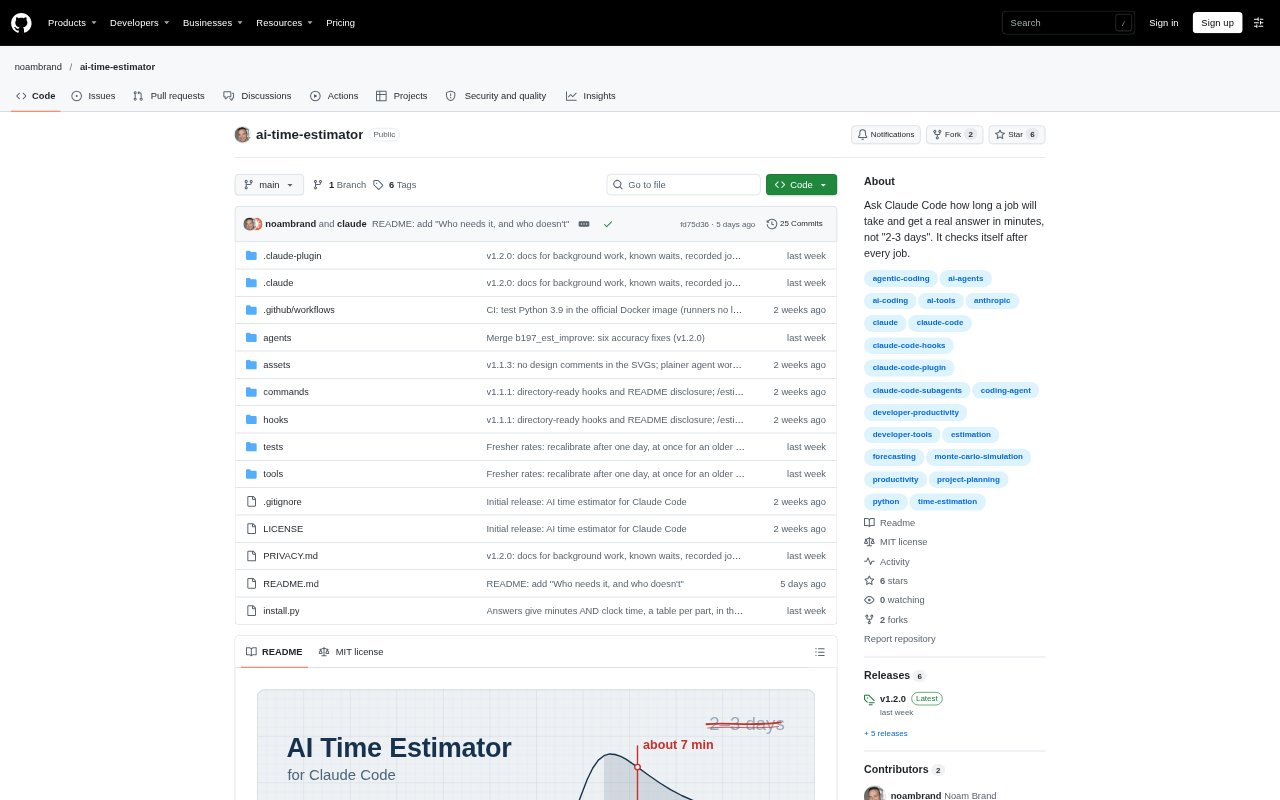
What is AI Time Estimator?
AI Time Estimator is an add-on for Claude Code that estimates how long a coding task will take in minutes, with a range and an expected finish time. It is for people who need to plan Claude Code work, set expectations with clients or colleagues, or decide what to tackle next. The estimator measures Claude’s work on your computer, checks its estimates against completed tasks, and adjusts its ranges as it learns from your sessions.
AI Time Estimator Features:
Time Estimates: Ask how long a task will take to get an estimate in minutes, a likely range, and the clock time it may finish.
Multiple Tasks: When you ask about several jobs at once, Claude presents an estimate for each in a table along with a total.
Work Scenarios: Estimates consider smooth, expected, and rough scenarios based on counts of files, edits, commands, and fix loops.
Machine Calibration: A script uses your computer’s measured Claude Code speed and past sessions to calculate the time estimates.
Automatic Checks: After a task, the add-on compares the estimate with the time Claude actually spent and learns from the result.
Local Processing: The add-on makes no network calls, reads Claude Code session history, and stores its estimates and scores on your computer.
In-Chat Estimates: Use the /estimate-here command to request an estimate in the current chat, then decide whether Claude should start.
AI Time Estimator Benefits:
Plan Your Day: A time range makes it easier to fit coding work around meetings and other commitments instead of relying on vague guesses.
Set Expectations: More grounded estimates help you give a client or manager a useful delivery expectation before work begins.
Choose Priorities: Comparing the expected effort of several jobs helps you choose what to start now and what can wait.
Notice Delays: Knowing the expected duration gives you a reference for spotting a task that is taking unusually long or getting stuck.
Keep Data Private: Local-only processing lets you use estimates without sending project or session information to an external service.
Use Cases:
Client Deadlines: Estimate a requested code change before telling a client when a report export or other feature could be ready.
Between Meetings: Check whether a small fix is likely to fit into a short gap or should be saved for a longer work session.
Dependent Tasks: Estimate an upstream coding task when another job, review, or demo cannot proceed until its output is ready.
Usage Planning: Use a task’s expected duration as a rough signal when deciding whether to start it under a limited usage allowance.
Long-Running Work: Compare elapsed time with the estimate when Claude seems to be looping or a task is taking longer than expected.
Workload Review: Look across estimates and completed tasks to understand where Claude’s work time goes and which steps merit attention.