

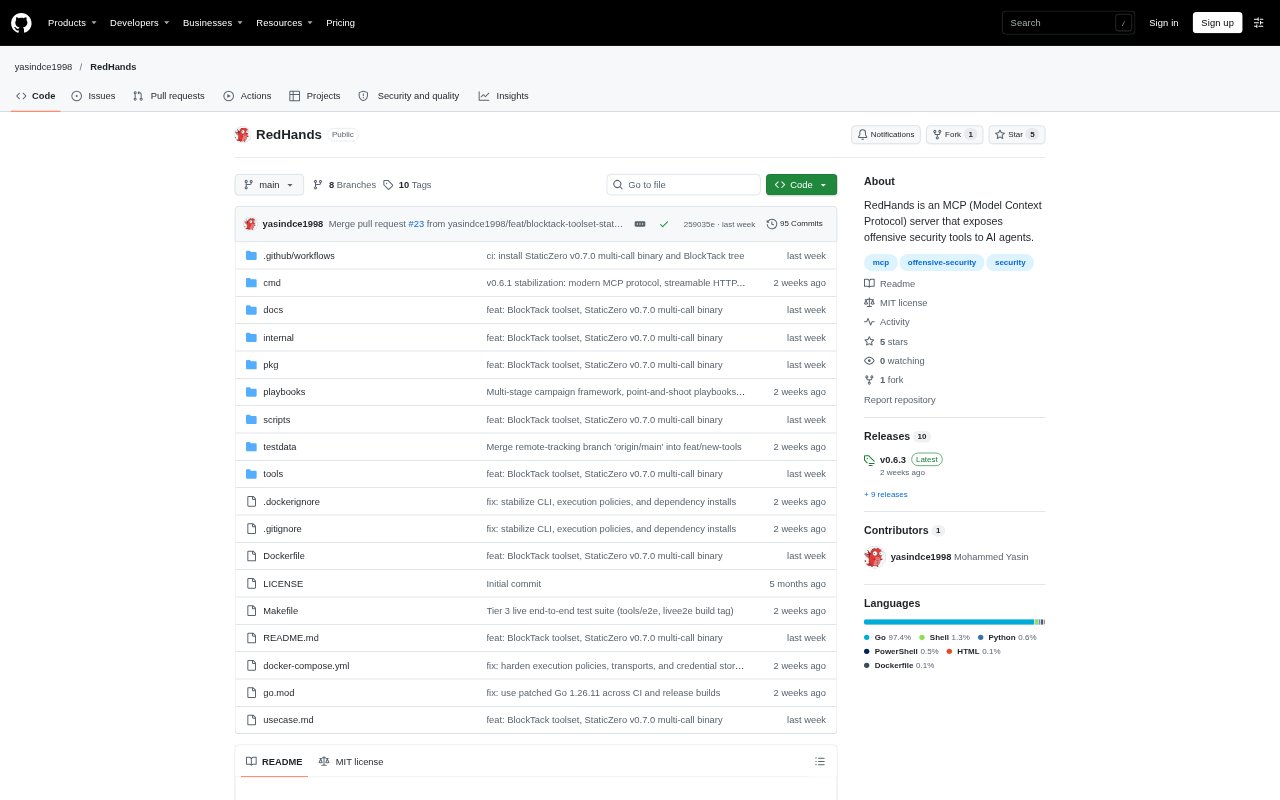
What is RedHands?
RedHands is an open-source MCP server that connects AI agents and MCP clients with offensive security tools for authorized assessments. It exposes security tasks through tool calls, with 294 tools registered across 36 toolsets and 287 available at default startup. Security teams can run it locally or configure its SSE and WebSocket transports for other setups. The project is written in Go and is available under the MIT licence.
RedHands Features:
Recon and Scanning: Toolsets cover port and service scans, subdomain enumeration, DNS lookups, web crawling, technology fingerprinting, and template-based vulnerability scans.
Web Testing: Available tools include HTTP probing, TLS checks, web fuzzing, directory discovery, and SQL injection detection.
Network and Access: Other toolsets include network tunneling, password cracking, Active Directory operations, and Sliver command-and-control tasks.
MCP Transports: The server supports stdio for MCP clients, as well as SSE and WebSocket transports, with remote SSE setup supporting TLS and authentication.
Workflow Support: RedHands includes tool chaining, structured parsing, report generation, a plugin system, rate limiting, caching, and audit logging.
Install Profiles: Dependency profiles group tools for minimal recon, web, network, Active Directory, Kubernetes, SBOM scanning, and other assessment areas.
RedHands Benefits:
Shared Interface: Teams can access many security utilities through one MCP server instead of switching between separate tool interfaces for each task.
Flexible Scope: Choosing a focused dependency profile helps teams prepare an environment around the kind of assessment they plan to run.
Connected Workflows: Tool chaining and structured parsing help keep related assessment steps and their outputs together.
Traceable Activity: Audit logging gives operators a record of activity while conducting security work.
Deployment Choice: Local stdio use and network transports let teams choose an operating setup that fits their MCP client or remote environment.
Use Cases:
External Recon: Use subdomain enumeration, DNS queries, archived URL collection, and port scans to map an authorized target's exposed surface.
Web Assessment: Combine crawling, technology identification, parameter discovery, fuzzing, and vulnerability scans while testing an approved application.
Network Review: Run service and port discovery, then use network toolsets to support an authorized infrastructure assessment.
Directory Testing: Use Active Directory and Kerberos toolsets during an approved review of an organization's Windows environment.
Dependency Scanning: Select the SBOM profile to generate software bills of materials and scan for vulnerabilities with Syft and Grype.