

What is Nischoy?
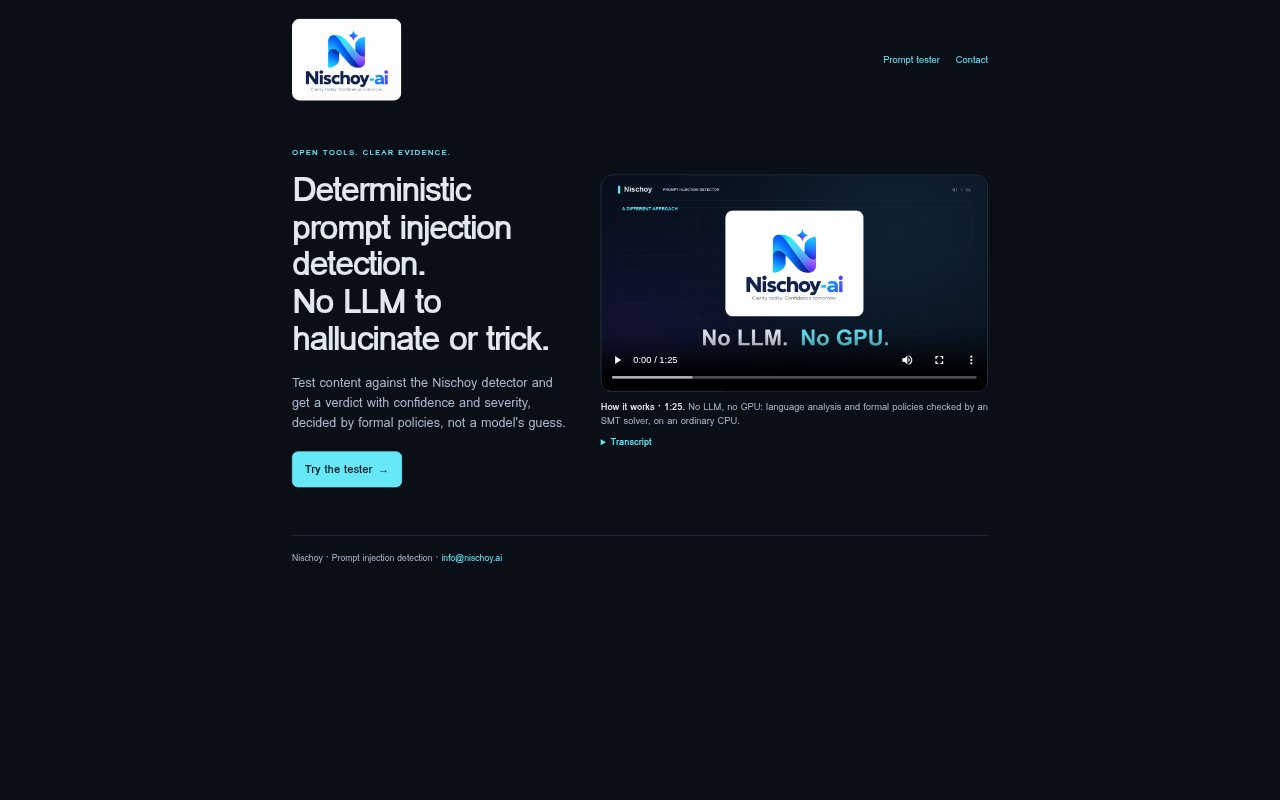
Nischoy detects prompt injection in text using language analysis and formal logic rather than an AI model. It is intended for teams building or operating AI agents that read untrusted material, including emails, web pages, and documents. Users can test content and receive a verdict with confidence and severity, along with the evidence and policies behind the decision. It runs on a CPU and returns the same result for the same input.
Nischoy Features:
Text Testing: Submit text to the detector and get a verdict on whether it contains a prompt injection, with confidence and severity.
Language Analysis: The detector analyzes the grammar of submitted text as an initial step in evaluating its meaning.
Action Extraction: It identifies what action a piece of text requests and the target that action is directed toward.
Formal Policy Checks: Executable policies written in formal logic are checked by an SMT solver to determine the verdict.
Deterministic Results: The detector gives the same answer for the same input instead of relying on a model's probabilistic judgment.
Decision Evidence: Each result can be traced to the extracted facts and the specific policies that fired, explaining the verdict.
Nischoy Benefits:
Repeatable Reviews: Consistent results make it easier to compare checks and build review processes that do not change with a model's varying responses.
Auditable Decisions: A traceable basis for each verdict helps reviewers understand and scrutinize why text was flagged.
Reduced Compute: Running without an LLM or GPU avoids dedicating those resources to a separate model watching an agent.
Fast Local Checks: In an in-process Apple M4 benchmark, the median check took 4.7 milliseconds; network time was excluded, and this is not a production latency measurement.
Clearer Triage: Confidence and severity give reviewers more context for deciding which flagged content needs attention first.
Use Cases:
Email Screening: Check an email an AI agent is about to read for instructions that could interfere with the agent's intended task.
Web Page Review: Test web page text before an agent uses it as input, looking for embedded directions aimed at the agent.
Document Checks: Review documents supplied to an AI workflow for text that attempts to redirect the agent's behavior.
Agent Input Audits: Examine external text sources consumed by an agent and inspect the evidence behind any injection verdict.
Injection Testing: Submit suspicious instructions, such as requests to ignore earlier directions, and see whether the detector flags them and why.